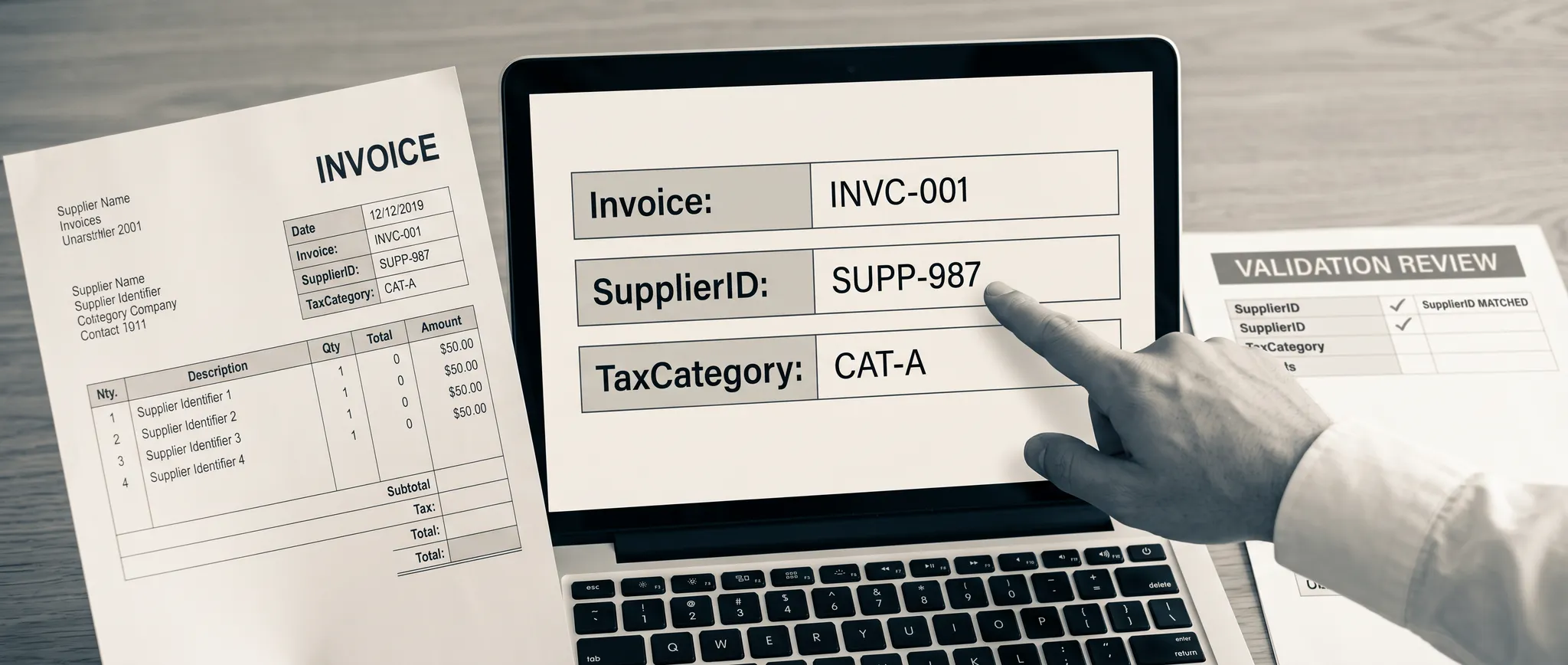
For most of the history of commerce, an invoice was a document sent from one company to another. Whether it was paper, a fax or a PDF attachment, the transaction stayed between the two parties until a tax authority asked to see it, usually years later, usually during an audit. European governments started dismantling that arrangement around 2011, and most finance teams treated it as a formatting change. The legal groundwork was already in place. Directive 2010/45/EU, amending the VAT Directive on invoicing rules, was adopted in July 2010 for transposition by 1 January 2013 — establishing equal treatment for paper and electronic invoices and requiring authenticity of origin, integrity of content and legibility to be assured from issue until the end of the storage period.[1] What looked like harmonisation of a technical detail was the legal foundation for something much larger: the state's direct participation in commercial transactions.
The Three Stages Nobody Announced
In hindsight, the trajectory ran through three distinct phases, and the mistake organizations made was assuming the first was the destination. Stage one: electronic invoices permitted. Paper and electronic acquire equal legal standing. Businesses can send structured invoices if both parties agree. This is optional, incremental and easy to ignore. Stage two: electronic invoices mandated. Specific sectors — initially public procurement — must issue and receive structured electronic invoices in a defined format. Selling to government requires compliance. This is no longer optional, but it is bounded. Stage three: the tax authority joins the transaction. Invoices must be submitted to, validated by, or cleared through a government platform, sometimes before they can legally be issued. Reporting moves from periodic to continuous. The state sees the transaction as it happens. Countries moved through these stages at different speeds and with incompatible technical choices, but the direction was consistent everywhere. Organizations that read stage one as "we can carry on emailing PDFs" spent the following decade responding to each mandate as an emergency.
Why This Is Not a Formatting Problem
The difference between a PDF and a structured electronic invoice is not the file type. It is that one is a picture of data and the other is data. A PDF can be wrong in ways nobody notices until someone reads it. A structured invoice submitted to a clearance platform is validated against tax registration data, format schemas and business rules, and rejected if it fails. That rejection is not a customer service problem; it is a legal one, because in clearance regimes an invoice that has not been accepted may not be a valid invoice at all. This changes what master data quality means. Incorrect tax registration numbers, wrong addresses, missing legal entity identifiers, unit-of-measure mismatches and inconsistent product codes had always existed in ERP systems, tolerated because the downstream consumer was a human who could work it out. Once a government platform is the consumer, every defect surfaces immediately and at volume. Most organizations discovered the true condition of their master data during their first mandate deadline, under time pressure, which is the most expensive way to find out.
The Fragmentation Problem
A single-country business faced one implementation. A multinational faced a different problem entirely, because each jurisdiction chose its own model — clearance versus post-audit reporting, different data schemas, different transmission protocols, different digital signature and archiving requirements, different timing rules — and continued to change them. That produced a permanent compliance obligation rather than a project. New mandates appear, existing ones change, thresholds shift, and each change requires work in the systems that generate invoices. Organizations that built one-off connections per country accumulated a portfolio of brittle integrations maintained by whoever happened to build them. The better response, adopted late by most, was to treat invoice compliance as a capability: one internal process generating clean structured data, and a specialist layer handling country-specific formats and transmission.
Practical Guidance for E-Invoicing Programmes
- Treat it as finance transformation, not an IT ticket. The work is master data, process and controls. Routing it to IT as a format change guarantees the underlying data problems survive.
- Audit master data before the deadline, not during. Tax registration numbers, legal entity details, customer addresses, product and unit codes. This is the single highest-value preparation and it takes longer than anyone estimates.
- Map every jurisdiction you invoice in, with its current and announced requirements. Include entities acquired recently and sales channels finance does not directly control.
- Separate invoice generation from country-specific compliance. One clean internal data flow, with a compliance layer handling formats and transmission. This is what makes the next mandate a configuration change rather than a project.
- Budget for continuous change. Mandates are amended regularly. A programme with an end date will be reopened. Fund the capability, not the deadline.
- Rehearse rejection handling. What happens operationally when a clearance platform rejects an invoice at month end. Who is notified, who fixes it, and what the effect is on revenue recognition and cash collection.
- Check archiving and integrity obligations. Retention periods, format, integrity assurance and accessibility for inspection differ by country and are frequently forgotten until an audit.
- Look at the upstream processes too. Mandates expose weaknesses in order management, pricing and contract data that invoicing merely reveals. Fixing them at source is cheaper than correcting invoices.
Map jurisdictions
Identify entities, channels and applicable current requirements.
Validate source data
Review tax identifiers, entity details, addresses and product codes.
Separate compliance handling
Keep internal invoice generation distinct from country-specific transmission.
Rehearse rejection
Name the correction owner and the operating response.
Maintain the capability
Review changes, archiving and integrity requirements.
Qualitative summary of this article's source text, not a measured outcome or performance estimate.
Why GCC Organizations Should Read This Closely
The Gulf is compressing a decade of European evolution into a few years. VAT introduction across the region was followed rapidly by electronic invoicing requirements, with Saudi Arabia implementing generation and then integration phases on an aggressive timetable and the UAE moving toward its own e-invoicing framework. Regional businesses therefore face the stage-three model without having lived through stages one and two, and frequently with ERP systems, master data and finance processes that were never built for machine-validated output. Organizations that treat this as a technical deadline will meet it and then struggle with every subsequent phase. Those that use it to fix master data and standardise invoice generation get a capability that handles whatever comes next — and in this region, something always comes next.
Where This Ends Up
The destination is visible and it is not really about invoices. Continuous transaction controls mean tax authorities hold near-real-time, transaction-level data about commercial activity. Audit changes character: rather than requesting records, the authority already has them and asks about the anomalies it has already identified. That has a consequence organizations are only starting to absorb. When the tax authority has better analytics over your transaction data than you do, the asymmetry is uncomfortable. Increasingly, authorities are applying automated analysis and machine learning to those feeds — detecting inconsistent margins, unusual counterparties and timing anomalies across an entire economy. The defensible position is to run the same analysis on your own data first. Organizations that know what their transaction data says before the authority asks are in a fundamentally different conversation from those finding out during an enquiry. That is the real reason to get the data clean, and it is a considerably better argument than meeting a deadline.
Common Questions
What did Directive 2010/45/EU change about invoicing?
It amended the VAT Directive to give paper and electronic invoices equal treatment, requiring authenticity of origin, integrity of content and legibility to be assured from issue until the end of the storage period. It was adopted in July 2010 for transposition by 1 January 2013.
What is the difference between a PDF invoice and a structured electronic invoice?
A PDF is an image of data that a person reads. A structured electronic invoice is machine-readable data validated automatically against tax registration details, schemas and business rules, and rejected if it fails — which in clearance regimes can mean no valid invoice exists.
Why do e-invoicing mandates expose master data problems?
Because errors in tax registration numbers, addresses, entity details and product codes were previously absorbed by human readers. Government validation platforms reject them automatically and at volume, surfacing every defect at once.
How should multinational organizations structure e-invoicing compliance?
By separating internal invoice generation from country-specific compliance, so one clean data flow feeds a specialist layer that handles differing formats, transmission protocols and archiving rules — making each new mandate a configuration change rather than a project.
E-Invoicing Readiness Review — Outpace audits the master data your invoices depend on, maps the mandates coming for the countries you sell in, and builds a compliance layer that absorbs the next change instead of breaking on it.