Before chat, before notifications, before anyone had heard the word "channel," the enterprise productivity crisis already had a name: email overload. And unlike most workplace complaints, this one came with numbers. Research from the period found the average corporate user receiving around 126 messages a day, with the share of the working day spent managing email rising from 17 percent in 2003 to 26 percent in 2006 and projected past 40 percent by the end of the decade. Forty percent of the working day. Not doing work — processing messages about work. That trajectory is the single most useful piece of context for every collaboration tool purchased since, because every one of them was sold as the solution to it, and the total communication load has increased in every year of the intervening two decades.
Why Email Became the Operating System
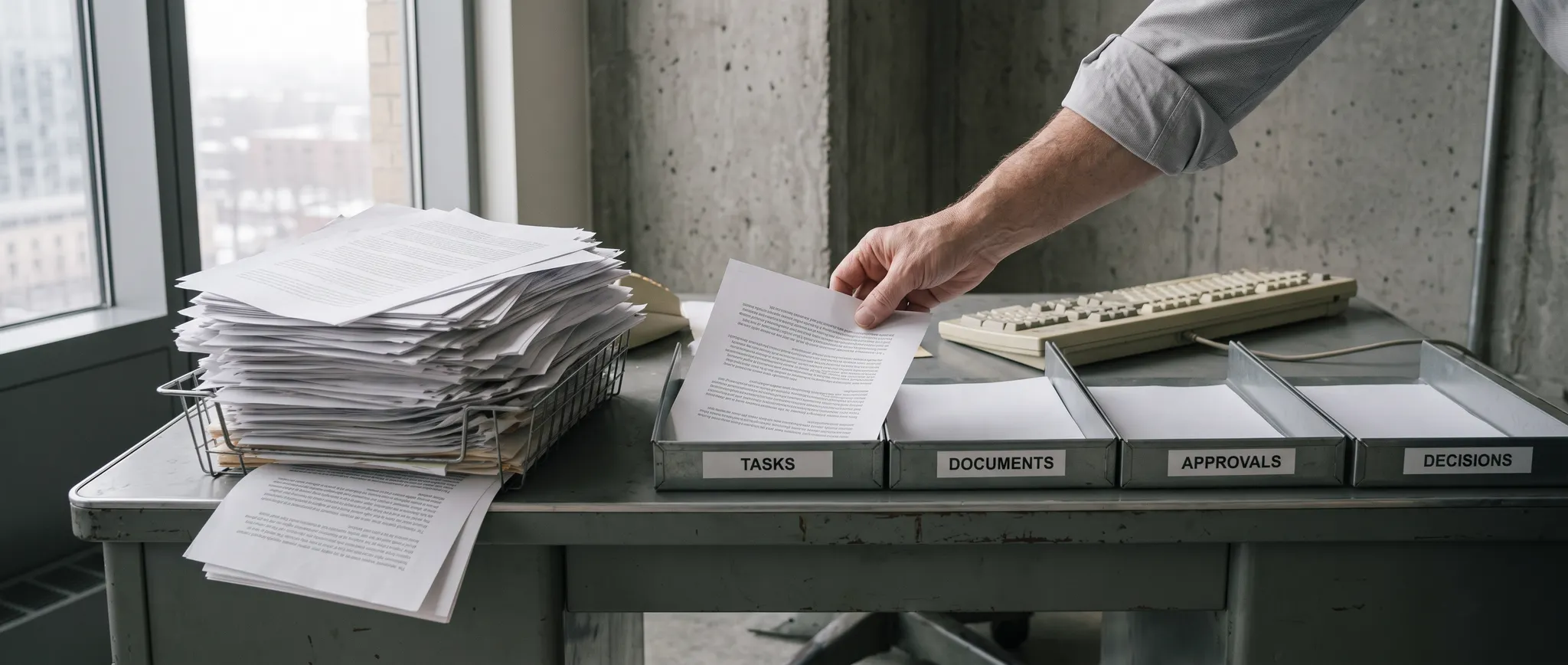
Email did not overwhelm people because there was too much of it. It overwhelmed people because it had absorbed functions it was never designed for. By 2008, a single inbox was simultaneously:
- The task list. Work arrived as messages, and the inbox became the queue. Flagged items were the backlog.
- The document repository. Version 7 of the budget existed as an attachment in a thread, and finding it meant searching your own mail.
- The approval workflow. "Approved" as a one-word reply constituted authorisation for spending, hiring and contracts.
- The decision record. Institutional memory lived in individual mailboxes, meaning a departure erased the reasoning behind a decision.
- The status meeting. Reply-all threads where twelve people watched two people argue.
- The notification system. Every system that wanted attention sent mail, because it was the only channel guaranteed to reach everyone. A tool doing six jobs badly is not an overload problem. It is an architecture problem, and no amount of inbox discipline fixes it.
The Interruption Research
The more damaging discovery of this era was not volume. It was fragmentation. Gloria Mark's work, presented in 2008, examined what interruptions actually do to task performance. The counterintuitive finding: people completed interrupted work faster, not slower — but at the cost of higher stress, frustration, time pressure and effort. That one result explains an enormous amount about modern work. Interrupted people compensate by working faster and cutting corners. Output volume holds up, so management dashboards show no problem, while the humans absorb the cost in stress and the organization absorbs it in errors, shallow thinking and turnover. This is why "we measured productivity and it was fine" is not a defence of a fragmented working environment. The metrics that degrade are the ones nobody measures.
What Didn't Work
A generation of remedies was tried on this problem, and most addressed the symptom. Inbox zero and email discipline training. Useful personally, useless structurally. Teaching individuals to process mail faster increases the throughput of a system whose input rate is set by everyone else. Email-free Fridays. Widely announced, quietly abandoned. The work did not stop; it queued and arrived on Monday. Filters and rules. Effective at hiding messages, ineffective at reducing the obligation to read them. Replacing email with chat. The most consequential mistake. Chat did not replace email — it was added to it. Organizations now run email, chat, project tools, notification streams, and meeting transcripts in parallel, and the aggregate load is substantially higher than the 126 messages a day that seemed intolerable in 2008. Economic mechanisms. Serious proposals existed to price attention — charging senders a virtual currency to reach a recipient. They failed for cultural reasons, but the underlying diagnosis was right: sending is free while receiving is expensive, and unpriced externalities always get overproduced.
What Actually Reduces Load
The interventions that work are structural. They change where information lives and who is obliged to consume it.
- Move the six jobs out of the inbox. Tasks into a task system, documents into a document system, approvals into a workflow, decisions into a written record. Email should carry correspondence, not carry the business.
- Make the default pull, not push. A status update published in a shared space is read by those who need it. The same update emailed to forty people creates forty obligations. Every broadcast should be a page someone can check, not a message everyone must clear.
- Kill reply-all by norm and by configuration. Cap distribution lists, disable reply-all on large lists, and treat a thread with more than five participants as a signal that a decision needs an owner rather than a discussion.
- Write decisions down where they belong. The single highest-return change most organizations can make is having a durable place for decisions and their rationale, so knowledge survives the departure of the person who made them.
- Set explicit response expectations. "Chat within the working day, email within two days, urgent goes by phone." Most anxiety about messaging is uncertainty about the expected latency, not the volume.
- Protect uninterrupted blocks deliberately. Given the evidence that interruption is absorbed as stress rather than as slower output, focus time has to be scheduled and defended rather than hoped for.
- Audit notifications annually. Every system defaults to emailing everything. Most of those notifications have never been read by anyone. Turning them off is the cheapest available intervention.
| Job in the inbox | Destination or discipline proposed |
|---|---|
| Tasks | A task system with an explicit work queue |
| Documents | A shared document system rather than attachment versions |
| Approvals | A workflow with recorded authorisation |
| Decisions | A durable written record and rationale |
| Status updates | A shared place people check rather than a broadcast obligation |
| Notifications | An annual audit and explicit response expectations |
Qualitative summary of this article's source text, not a measured outcome or performance estimate.
The AI Turn
The current wave of tooling promises to solve overload by summarising it: inbox digests, thread summaries, automatic meeting notes, drafted replies. Some of this genuinely helps — particularly summarisation of long threads and transcripts you would otherwise have to read in full. But there is an obvious risk, and it is already visible. If generating a well-written message costs nothing, the volume of well-written messages rises. Assistance on the sending side increases load faster than assistance on the receiving side reduces it, and both sides are being automated simultaneously. The organizations that will benefit are the ones that use AI to reduce the number of messages that need to exist — by improving the written record, answering questions from documentation rather than by asking a person, and summarising rather than forwarding — instead of using it to produce more communication more fluently.
Common Questions
Is email still the biggest source of communication overload?
No. Email plus chat plus project tools plus notifications together now exceed the load that email alone created in 2008. Chat was added to email rather than replacing it.
Does interruption reduce productivity?
Research found interrupted tasks were completed faster, but with measurably higher stress, frustration and effort. The cost appears in quality, wellbeing and turnover rather than in throughput, which is why it is often invisible to management reporting.
What is the most effective way to reduce email volume?
Move tasks, documents, approvals and decision records out of email into systems designed for them, and shift status information from broadcast messages to shared spaces people check.
Do AI summaries help with overload?
They help on the receiving side. They also make producing messages easier, which increases volume. The net benefit depends on whether you use AI to reduce the number of messages required, not just to digest them faster.
Communication Load Review — Outpace measures where your team's attention actually goes across email, chat and notifications, moves tasks, approvals and decisions into systems built for them, and sets response norms people can rely on.