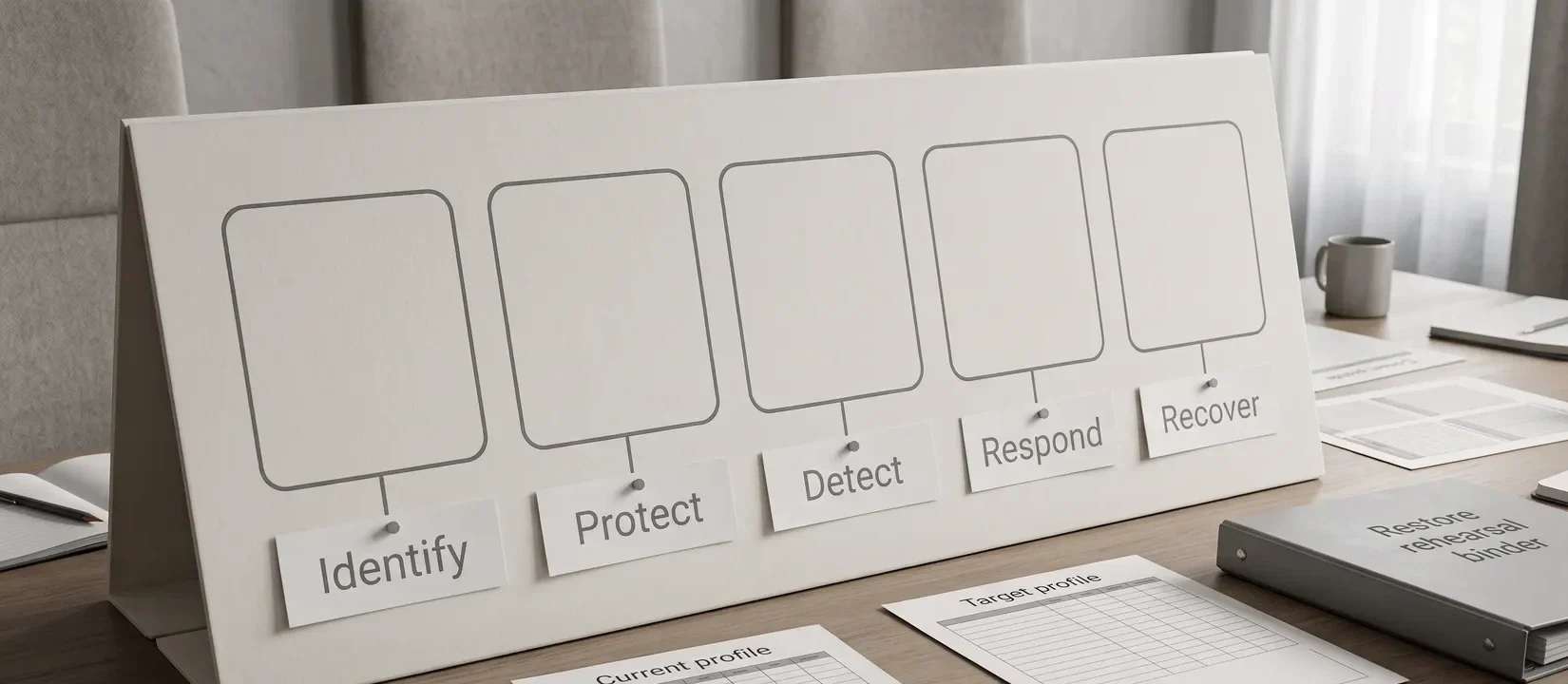
Executive Order 13636, "Improving Critical Infrastructure Cybersecurity", was signed on 12 February 2013 and gave the National Institute of Standards and Technology a year to produce something that had not previously existed: a voluntary, non-prescriptive framework that critical infrastructure operators could use to describe and improve their cybersecurity posture. Version 1.0 arrived in February 2014. The drafting year is the interesting part. NIST ran it as an open process — requests for information, public workshops, draft circulation, comment — and what emerged was shaped substantially by the operators who would have to use it. That is why it looks the way it does, and it is why it succeeded where more detailed standards had not.
What They Deliberately Did Not Build
The design decisions that made the framework useful were mostly decisions about restraint. No control list. There were already plenty — ISO 27001, NIST SP 800-53, the PCI requirements, sector-specific rules. Producing another would have created another mapping exercise and another compliance burden. The framework instead organised outcomes and referenced the existing standards as implementation options. No certification. Voluntary, with no audit, no certificate and no pass mark. This was contentious at the time and turned out to be essential: it meant an organization could assess itself honestly without the result becoming a commercial liability. Certifiable standards produce optimised evidence; unenforced frameworks produce more truthful self-assessment. No sector specificity in the core. Five functions — Identify, Protect, Detect, Respond, Recover — broken into categories and subcategories that apply to a utility, a bank, a hospital and a manufacturer. Sector adaptation happened through profiles rather than through separate documents. And no maturity model in the conventional sense. The implementation tiers describe how integrated risk management is with the business, not how many controls are implemented. An organization can be at a high tier with modest controls if those controls reflect a deliberate, informed risk decision.
Why the Five Functions Mattered
The structure looks obvious in retrospect, which is usually the sign of a good abstraction. Its practical contribution was forcing balance. Security spending in this period was heavily concentrated in Protect. Firewalls, antivirus, access control, encryption — the preventive controls. Detect was underfunded, Respond was a document nobody had rehearsed, and Recover was assumed to be the backup team's problem. Laying the five functions side by side made that imbalance visible in a way that a control list did not. An organization could demonstrate extensive Protect coverage and near-zero Detect capability, and the framework made that a conversation rather than a footnote. Given what the following decade looked like — breaches undetected for months, ransomware defeating organizations whose recovery had never been tested — that rebalancing was the framework's most valuable contribution. The second contribution was linguistic. It gave executives, technical teams, auditors, regulators and suppliers a shared vocabulary. "We are strong on Protect, weak on Detect, and our Recover capability is untested" is a sentence a board can act on. That sounds trivial and it was not; the absence of common language had been a genuine obstacle to funding.
How It Is Actually Used
The intended method is current profile, target profile, gap analysis, prioritised action plan. In practice the useful applications turned out to be somewhat different. As a board reporting structure. Five functions, scored, with trend. It is the most widely adopted cybersecurity reporting format in existence, and the reason is that it fits on one slide and non-technical directors can follow it. As a supplier assessment tool. Framework-aligned questionnaires became a standard part of third-party risk management, which turned a voluntary framework into a de facto contractual requirement for anyone selling into large organizations. As a translation layer between standards. Organizations subject to several regimes used the framework to map overlapping obligations onto one structure, which reduced duplicated evidence collection considerably. And as an acquisition due diligence template. A fast, structured way to assess a target's security posture without a full audit.
Where It Falls Down
Honest use requires knowing the limits. Self-assessment scores drift upward. Without external validation, subcategory ratings reflect optimism. A programme that scores itself consistently and improves every year may be improving its scoring rather than its security. It describes outcomes, not how to achieve them. "Detect: anomalies and events are analysed to understand attack targets and methods" is a sound objective and not an implementation plan. Teams expecting prescriptive guidance find the framework frustrating and conclude it is vague. It is deliberately vague; the specifics live in the referenced standards. Coverage is not effectiveness. An organization can implement something in every subcategory and be genuinely insecure, because the framework does not test whether the controls work. Nothing in a self-assessment substitutes for adversarial testing. It can become a compliance exercise. The moment the score becomes a target, the assessment becomes an exercise in producing the score. This happened widely. And the sector-agnostic design means every organization must do the interpretation work. A small manufacturer and a national bank read the same subcategory and need very different answers. The framework provides no help with that, by design.
Practical Guidance for Framework Adoption
- Use it as a communication structure first. Its highest-value function is giving the board, the technical team and suppliers one vocabulary for the same problem.
- Score honestly or do not score. An assessment optimised to look good is worse than no assessment, because it substitutes for the real one.
- Check the balance across all five functions. Heavy Protect investment with thin Detect and untested Recover is the most common and most dangerous profile.
- Validate the self-assessment externally at least every other year. Internal scores drift; an outside view resets them.
- Test effectiveness separately. Coverage against subcategories says nothing about whether a control stops an attacker. Red teaming and restore testing do.
- Build a target profile that reflects your risk, not a maximum score. Not every subcategory deserves equal investment in every organization.
- Use it to map overlapping regimes. If you are subject to several standards, one structure with mapped evidence saves substantial duplicated effort.
- Re-baseline after any structural change. Acquisitions, cloud migrations and major outsourcing arrangements invalidate the previous profile.
The Regional Application
For organizations in the Gulf, the framework arrived into a landscape that has since become considerably more prescriptive — which changes how it should be used. The UAE and Saudi Arabia have both developed national cybersecurity authorities with published control frameworks, and these are not voluntary. Regulated entities face binding requirements covering governance, technical controls, incident reporting timelines and, in several sectors, data residency. Financial services regulators, including those governing DIFC and ADGM entities, layer further obligations. Critical national infrastructure designations bring their own regimes. In that environment the framework's role is not as the governing standard but as the connective structure. Its practical value regionally is threefold. It maps mandatory regimes to one picture. A group operating across the UAE, Saudi Arabia and Qatar faces several overlapping control catalogues with substantial common ground and different vocabularies. Mapping them onto five functions produces a single view that shows where obligations overlap and where a genuine gap exists in only one jurisdiction. It supports board reporting to internationally composed boards. Where directors come from several jurisdictions and regulatory backgrounds, a globally recognised structure communicates better than a national control catalogue. And it fills the space below the regulated threshold. The large population of regional SMEs and mid-market groups that fall outside mandatory regimes have no obvious starting point. A voluntary, non-certifiable, freely available framework is exactly the right instrument for that segment, and it is underused there. Two regional cautions apply. Incident reporting timelines under local requirements are specific and in some cases short, so the Respond function needs the regulatory clock built into it rather than treated as a general capability. And data residency obligations affect architecture decisions that the framework treats as neutral — where logs are stored, where monitoring is performed and who can access security telemetry are all live questions here.
Each event links to its supporting source. This is a selective chronology, not a performance comparison.
The Framework's Own Evolution
Version 1.1 added supply chain risk management, reflecting a decade in which third-party compromise became the dominant intrusion path. Version 2.0 added a sixth function, Govern, and broadened the scope explicitly beyond critical infrastructure to all organizations — acknowledging what had already happened in practice. The Govern addition is the more interesting one. It formalised what practitioners had learned the hard way: that most security failures are not control failures but governance failures. Unclear accountability, risk decisions made by people without authority to make them, policy that does not match practice, and supplier arrangements nobody owns. The same structure is now being applied to AI risk, and the parallel is instructive. The questions are recognisable — what models are in use and who approved them, what data reaches them, how outputs are validated, how failures are detected, what the recovery position is when a model produces harmful output at scale. NIST's separate AI risk management work follows a similar philosophy: voluntary, outcome-focused, deliberately non-prescriptive. Whether that approach works a second time is not yet clear. The 2013 framework succeeded partly because the underlying practices were reasonably well understood and the problem was getting organizations to apply them consistently. AI risk is less settled than that. But the structural insight holds: when the technology is moving faster than any control catalogue can track, a framework that organises outcomes and leaves implementation open ages considerably better than one that specifies the controls.
Common Questions
What is the NIST Cybersecurity Framework?
A voluntary, outcome-focused structure organising cybersecurity activity into functions — originally Identify, Protect, Detect, Respond and Recover, with Govern added later — broken into categories and subcategories, with references to existing standards for implementation. It was directed by Executive Order 13636 in February 2013 and published in February 2014.
Why is it voluntary and non-certifiable?
Because certification produces optimised evidence rather than honest assessment. Without an audit or a pass mark, an organization can rate itself truthfully, including in areas where the answer is uncomfortable, and use the result to argue for investment.
What is its main practical benefit?
A shared vocabulary between boards, technical teams, auditors and suppliers, and a structure that exposes imbalance — particularly the common pattern of heavy preventive investment with weak detection and untested recovery.
Is it useful in jurisdictions with mandatory national frameworks?
Yes, as a connective structure rather than the governing standard. It maps overlapping regimes onto one picture, communicates to internationally composed boards, and provides a starting point for organizations that fall below mandatory regulatory thresholds.
Framework Alignment Assessment — Outpace maps your obligations across regimes onto one structure, finds the imbalance, and tests whether the controls actually work.