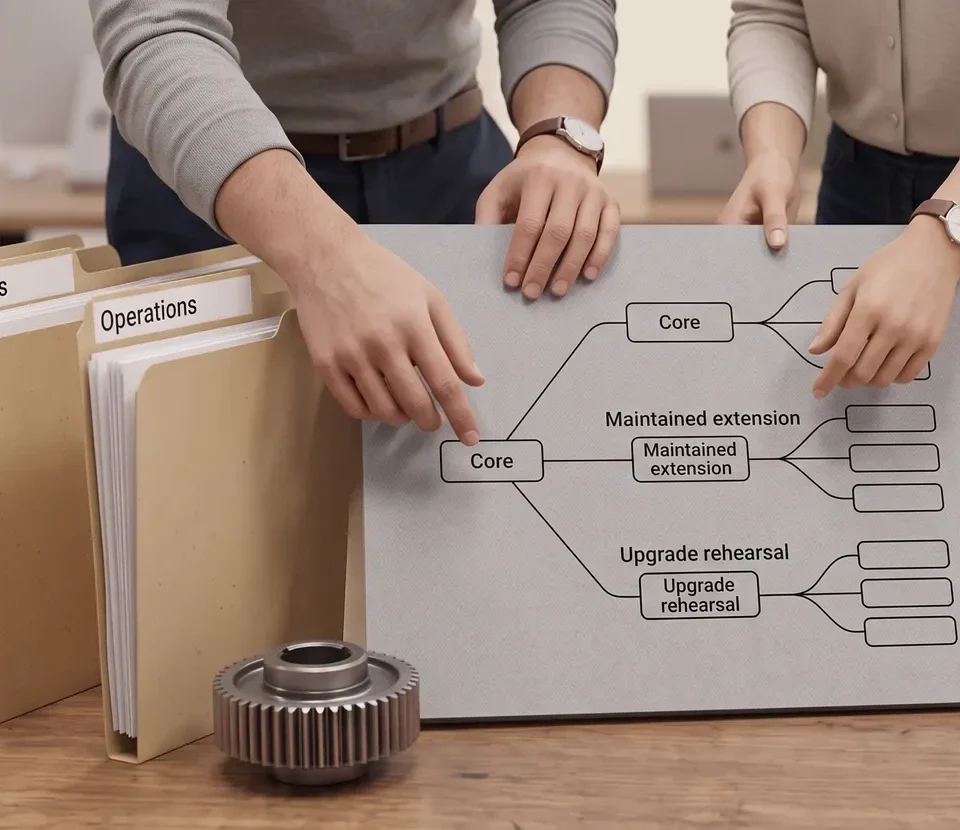
Open source ERP arrived with a proposition that sounded unanswerable to any finance director who had just been quoted six figures for licences: the software is free. Download it, install it, keep the money. By 2009 a small cluster of projects — Compiere, its fork ADempiere, Openbravo and a handful of others — had enough maturity, enough reference sites and enough community activity to be taken seriously by mid-market buyers. Very few of those buyers ended up saving what they expected, and the reasons have almost nothing to do with software quality.
What the Movement Actually Was
Compiere was the anchor. It pioneered what later became the standard commercial approach in this segment: a free entry-level product with a paid commercial edition and services around it, or, as one long-time observer of the project described the evolution, from a free product with revenue from services to an "open core" model with a real commercial product alongside it. That model created the tension that defined the whole category. Community contributors wanted an open product. The company needed revenue. In 2006 the disagreement produced ADempiere, a fork of the last community version, which inherited the architecture and added PostgreSQL support and a range of community extensions. Openbravo took a different route, building a web-native product with its own commercial model and attracting mainstream investment attention. A later fork, iDempiere, arrived in 2012 with a rearchitected technical foundation. The lineage is still alive, which is more than can be said for many proprietary products of the same vintage.
Where the Savings Went
The licence is the smallest line item in an ERP programme. Removing it changes the total by less than most buyers assume, and the open source model actively increases several other lines. Implementation skill became scarce and therefore expensive. A large vendor has a partner ecosystem with thousands of certified consultants competing on price. An open source project had a handful of specialists. Scarcity sets the rate, and the day rates for genuinely competent implementers frequently exceeded those of mid-market proprietary partners. Free software removes the friction that limits customisation. With no vendor telling you what is supported and no upgrade charge visible on the horizon, teams modified the core freely. That produced systems perfectly fitted to the business in year one and effectively unupgradeable by year four — the same technical debt trap as proprietary ERP, entered faster because nothing said stop. Support arrangements were often notional. "The community supports it" is true in the sense that a forum exists. It is not true in the sense that anyone has an obligation to you at month-end when postings will not generate. Buyers who paid for a commercial support subscription got real support; buyers who relied on goodwill did not. Functional depth was uneven. Core financials, distribution and basic manufacturing were credible. Statutory reporting for a given country, industry-specific compliance, and payroll rarely were — and the gap had to be filled with custom development that then needed maintaining forever. Fork risk was real. Organizations that adopted Compiere before the ADempiere split had to choose a path afterwards, with no vendor to make the decision for them. Governance of the project turned out to matter as much as the code.
The Buyers Who Succeeded
Open source ERP worked well for a specific profile, and it still does. They had genuine internal technical capability — not "we have an IT manager," but developers who could read the code and take responsibility for it. They stayed close to standard, treating the availability of the source as an insurance policy rather than an invitation. They bought commercial support from a competent partner instead of relying on forums. And they valued the strategic benefits — no licence audits, no per-user pricing escalation, no risk of the vendor discontinuing the product — more than they valued the headline saving. That last point is the honest case for open source ERP, then and now. It is not cheaper. It is ownable, and for organizations operating in markets where a proprietary vendor may not maintain a local presence, or where data must stay on infrastructure you control, ownership has a value that does not show up in a licence comparison.
| Area | Evidence to obtain |
|---|---|
| Total cost | Implementation, hosting, support, staff and upgrade assumptions. |
| Support continuity | Available maintainers and a defined incident obligation. |
| Governance | Roadmap control, contributions and fork/ownership history. |
| Local fit | Statutory coverage and a disciplined customisation/upgrade test. |
Qualitative summary of this article's source text, not a measured outcome or performance estimate.
Evaluating Open Source Business Software Today
- Model total cost over five years, not licence cost. Implementation, configuration, custom development, hosting, support subscription, internal staff, and the upgrade effort per release.
- Test the support market, not the software. How many firms can implement and support this in your country? Call three. If the answer is one, you have a dependency, not a choice.
- Check the governance. Who controls the roadmap, how are contributions accepted, how is the commercial entity funded, and what happened the last time the community and the company disagreed?
- Measure the real community. Commit frequency, number of distinct active contributors, release cadence, time to resolve reported defects. A busy forum and a stale repository is a warning sign.
- Verify the statutory gap. Local tax, VAT treatment, e-invoicing mandates, payroll and regulatory reporting for every country you operate in. This is where open source deployments most often need bespoke work.
- Set a customisation policy before you start. Access to source code makes discipline harder and more important, not less.
- Plan your upgrade path deliberately. Who applies releases, how are your changes reapplied, and how far behind are you willing to fall?
The Modern Echo
The same reasoning now plays out over open-weight AI models and self-hosted platforms. Free to obtain, expensive to operate well, attractive for exactly the reasons open source ERP was attractive — no per-seat escalation, no vendor lock-in, and complete control over where your data sits. The lesson from 2009 transfers intact: the licence was never the cost, the skills are, and the value of open source is control rather than price. Organizations that adopt it for the first reason usually do well. Organizations that adopt it for the second usually pay twice.
Common Questions
Is open source ERP actually cheaper?
Rarely, in total. Removing the licence fee changes a small share of programme cost while increasing reliance on scarce implementation skills. The real benefits are control, independence and freedom from per-user pricing escalation.
What happened to Compiere, ADempiere and Openbravo?
Compiere moved toward an open core commercial model and was later acquired; ADempiere forked from it in 2006 and remains community-run; iDempiere forked again in 2012 with a new technical architecture. Openbravo pursued its own web-native commercial path.
What is the biggest risk with open source ERP?
Uncontrolled customisation. Access to source code removes the friction that normally limits modification, which produces systems that fit perfectly at first and cannot be upgraded later.
When does open source ERP make sense?
When you have genuine internal technical capability, can buy commercial support from a competent local partner, intend to stay close to standard, and value ownership and data control over headline savings.
Open Source ERP Evaluation — Outpace compares open source and proprietary options on five-year total cost, local support depth, statutory coverage and governance risk, so the decision rests on evidence rather than the licence line.