For most of the previous decade, open source ERP was a category that finance directors had heard of and nobody serious deployed. The software existed — Compiere, Openbravo, OpenERP, later iDempiere — and it worked, in the sense that it posted journals and tracked inventory. What it did not do was look like something you could run a business on. The interfaces were dated, the implementation partner networks were thin, and the reference customers were small. Odoo 7.0, released in 2013 under what was then still the OpenERP name, is a reasonable marker for when that stopped being automatically true. The release was notable less for any single feature than for a shift in posture: a genuinely modern web interface, a coherent modular structure, and a presentation that no longer required a prospective buyer to imagine what the product might become. That did not make it the right answer for most enterprises. It did make the evaluation a real one for the first time.
What Changed in the Product
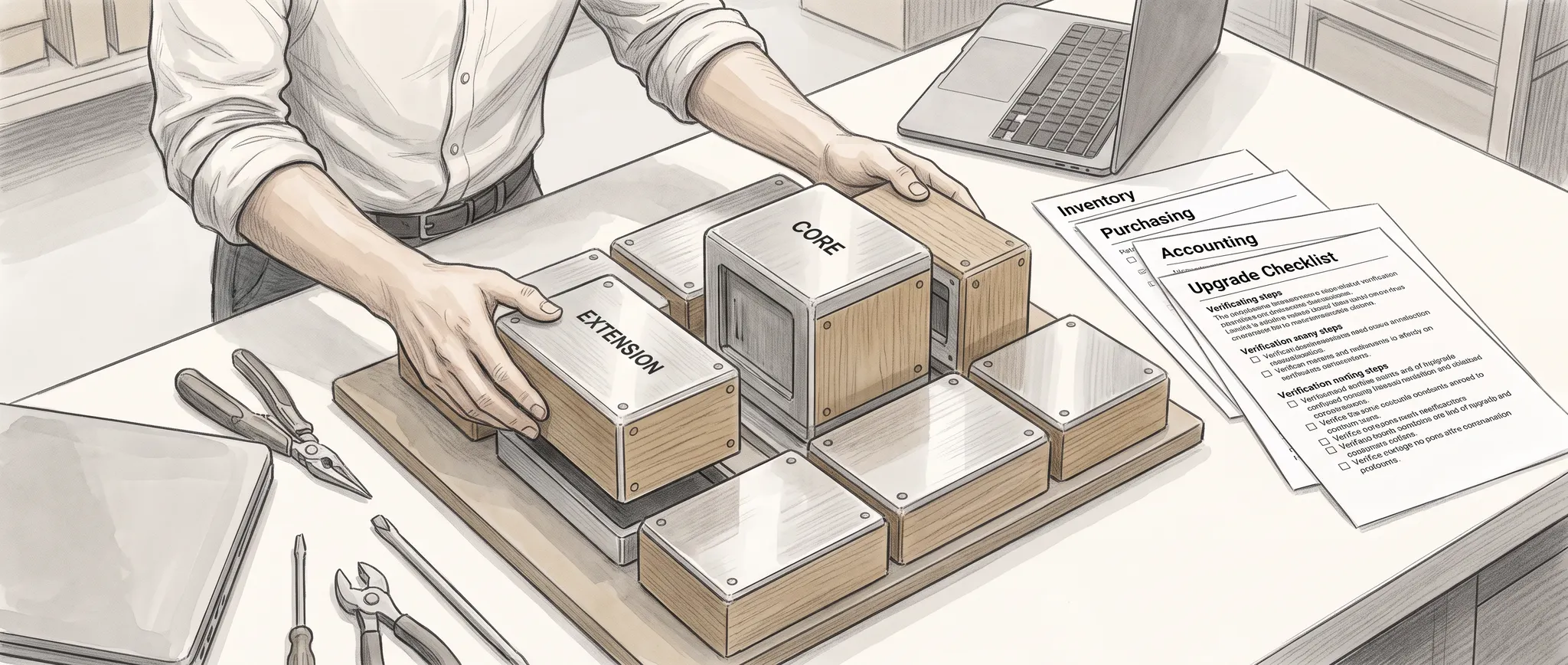
The Belgian company behind it had spent several years moving from a desktop client to the browser, restructuring the application around discrete modules, and building out a functional footprint that covered accounting, inventory, purchasing, sales, manufacturing, project management and point of sale. The 7.0 release consolidated that work. The interface was cleaner than several commercial mid-market products of the period. Module installation was genuinely modular — you could run accounting and inventory without carrying manufacturing. The developer framework was coherent enough that building an extension did not require reverse-engineering the core. The licensing history around this period is worth noting because it shaped adoption. The project moved away from a pure GPL position toward the AGPL, which closes the network loophole — hosting a modified version as a service triggers the obligation to publish the modifications. Later versions split into a free community edition and a paid enterprise edition, which changed the calculus again. Buyers evaluating open source ERP at any point in this period needed to read the licence that applied to the version they were actually deploying, and many did not.
The Argument That Was Actually Persuasive
The licence fee saving was the headline and was rarely the real reason organizations chose this route. No per-user licence cost changes who gets access. In a commercial ERP with per-seat pricing, organizations ration access. Warehouse staff do not get accounts. Field technicians submit paper. Junior finance staff share logins. Removing the marginal cost of a user changes that calculation, and the operational benefit of everyone working in the system usually exceeds the licence saving. Source access changes the vendor relationship. With a commercial product, a required change that the vendor will not build is simply unavailable. With source access, it is a cost and a maintenance commitment, but it is possible. For businesses with genuinely unusual processes, that difference is the whole decision. Exit is not hostage-taking. The data is in a documented schema in a standard database. Migration away is a project rather than a negotiation, which materially changes the balance of power at renewal time. And the entry cost fits a real segment. A growing business outgrowing spreadsheets and a small accounting package, with limited capital and a tolerance for hands-on technology, faced a choice between a commercial mid-market product with a six-figure first-year cost and something they could stand up for the cost of an implementation partner's time.
The Costs That Buyers Systematically Underestimated
This is where most open source ERP disappointments originated, and the pattern was consistent. Implementation cost dominates, regardless of licence. Process design, configuration, data migration, integration, testing, training and change management are the bulk of any ERP project's cost. Removing the licence fee removes perhaps fifteen to twenty-five percent of first-year cost and none of the difficulty. Organizations that saved on the licence and then underfunded the implementation got exactly the outcome that underfunded implementations always get. Version upgrades punish customisation severely. This is the single most important practical difference. The community release cadence was frequent, and modifications to core code — as opposed to properly structured module extensions — had to be reworked at every upgrade. Organizations that customised heavily found themselves either stranded on an old version with no security patches, or paying repeatedly for the same work. The discipline required to extend cleanly rather than modify core is real, and it requires a technical lead who understands the framework and the authority to say no. Support is a market, not an entitlement. Community forums are genuinely helpful and are not a service level agreement. Production support means either an internal capability or a contract with a partner, and partner quality in this market varied enormously. The good partners were excellent; the weak ones left customers with half-finished implementations and code nobody could maintain. The functional gaps were real at the edges. Core accounting, inventory and purchasing were solid. Complex manufacturing, multi-entity consolidation, sophisticated revenue recognition, advanced warehouse management and industry-specific regulatory functionality were where commercial products remained substantially ahead. Buyers who evaluated against their core processes and ignored their edge cases discovered the gaps during user acceptance testing. And audit conversations took longer. Not because the software was less controllable — it was not — but because auditors unfamiliar with the platform asked more questions about change management, access control and the integrity of the deployment. That is an overhead, particularly for regulated entities.
| Ownership area | Evaluation question |
|---|---|
| Implementation | Who designs processes, migrates data and tests difficult transactions? |
| Extensions and upgrades | Who maintains modules and regression tests without changing core code? |
| Production support | Who owns incidents under a support agreement? |
| Localisation and controls | Which regulatory outputs and access controls have been demonstrated? |
| Exit | Can the buyer obtain data, configuration and customisation code? |
Qualitative summary of this article's source text, not a measured outcome or performance estimate.
How to Evaluate It Honestly
Score the functional fit against your actual processes, including the awkward ones. Not a feature checklist. A structured walkthrough of your five most complex recurring transactions, performed in the product, with your data. Model total cost over five years, not one. Implementation, partner fees, hosting, internal technical capability, upgrade effort and the cost of maintaining customisations. The licence line is one row among many. Assess the partner, not just the software. For open source ERP the partner is the more important decision, because there is no vendor to escalate to. Reference customers of similar size and complexity, in your region, running the version you intend to deploy. Commit to a customisation discipline in advance. Extend through modules; never modify core. Write it into the implementation contract. This one decision determines whether upgrades are routine or catastrophic. Be realistic about internal capability. Running this well requires someone who understands the framework. If that person does not exist and will not be hired, the model does not work regardless of how good the software is.
Practical Guidance for Evaluating Open Source ERP
- Treat the licence saving as the smallest line in the business case. Implementation, integration and change management dominate the cost of any ERP project.
- Make "no core modifications" a contractual requirement. It is the difference between an upgradeable system and a permanently frozen one.
- Read the licence that applies to the version you will deploy. Community and enterprise editions differ, and the AGPL has real implications if you host a modified version as a service.
- Evaluate the implementation partner as the primary vendor decision. There is no software company to escalate to when the project stalls.
- Walk through your hardest transactions in the product before signing. Core functionality is strong; the gaps are at the edges and the edges are where your business is unusual.
- Budget for internal technical capability, not just external support. Community support is not a service level.
- Plan the upgrade path before go-live. Decide who does it, how often and against what test suite. Organizations without that plan stop upgrading within two years.
- Include a security patching commitment. Staying on an unsupported version because upgrading is painful is a security decision made by default.
The Regional Picture
In the Gulf, open source ERP has occupied a specific and fairly stable niche, and the reasons are structural. The region has a large population of owner-managed businesses, trading companies and SMEs that are too complex for entry-level accounting software and cannot justify a commercial mid-market ERP with its licence and implementation profile. For that segment the economics are genuinely compelling, and a substantial partner ecosystem has grown in the UAE and India to serve it. The complications are local and they matter. Tax and e-invoicing compliance arrives on the regulator's timetable. VAT introduction across the GCC, UAE corporate tax and the phased ZATCA e-invoicing requirements in Saudi Arabia each demanded specific functionality within fixed windows. Commercial vendors shipped localisation updates as part of maintenance. Open source deployments depended on the community or the partner producing a localisation module in time, and the quality varied considerably. Businesses that had customised heavily found themselves needing to implement a regulatory change on top of a modified core, which is the worst combination available. Arabic support is more than translation. Right-to-left interface rendering, Arabic invoice and document templates, bilingual master data for customers and suppliers, and Arabic-capable printing all need to work properly. This has improved substantially over time and was a genuine weakness in the earlier period. Payroll is usually not attempted. UAE Wage Protection System file generation, end-of-service gratuity calculation, GOSI contributions and Saudisation tracking are specific, regulated and change. Most regional deployments run payroll on a dedicated local product and integrate, which is the right answer. Free-zone and mainland structures multiply entities. Groups with several entities across jurisdictions need multi-company handling, intercompany transactions and per-entity statutory reporting. This is an area where the community edition historically required more work than buyers expected. The pattern that has worked regionally is consistent: use it where the business is genuinely straightforward in its core transactions, insist on a strong local partner with regulatory-compliance track record, keep customisation minimal, and do not attempt to make it do payroll.
What the Category Became
The strategic question has moved. The commercial vendors that open source ERP was positioned against have largely moved to subscription cloud models, which changed the comparison entirely. The argument is no longer perpetual licence versus free software; it is subscription versus self-hosted, and the relevant variables are control, data residency, customisation freedom and the cost of running infrastructure. Odoo itself moved to a community-plus-enterprise model, which put it in roughly the same commercial territory as the products it once undercut, while retaining the source access and the extension framework. The newer version of the same argument is about AI. Commercial cloud vendors are embedding AI capability into their platforms as part of the subscription — document processing, forecasting, anomaly detection, conversational reporting — and doing so at a pace that a self-hosted deployment has to match by integration rather than by upgrade. That is achievable, and it requires exactly the internal technical capability that open source ERP has always required. The organizations with that capability are fine. The ones who chose open source primarily to avoid a licence fee, and never built the capability, are further behind than they were. Which is the same conclusion the 2013 evaluation should have reached. Open source ERP is not cheaper software. It is a different allocation of cost and control — less to the vendor, more to your own team — and it works precisely as well as the team you allocate it to.
Common Questions
Is open source ERP actually cheaper?
The licence fee disappears, which is typically fifteen to twenty-five percent of first-year cost. Implementation, data migration, integration, training, hosting, support and upgrade effort remain and dominate the total. Over five years the saving is real but far smaller than the headline suggests.
What is the biggest practical risk?
Customisation of core code. Frequent release cadence means modifications must be reworked at every upgrade, and organizations that took this path frequently stopped upgrading — which means running without security patches. Extending through properly structured modules avoids it entirely.
Where does open source ERP fall short functionally?
Core accounting, inventory, purchasing and sales are solid. Complex manufacturing, multi-entity consolidation, advanced warehouse management, sophisticated revenue recognition and industry-specific regulatory functionality are where commercial products have generally remained ahead.
Does it work for businesses in the Gulf?
It works well for straightforward single-entity or small-group operations with a strong local partner. The complications are tax and e-invoicing localisation arriving on the regulator's timetable, proper Arabic and right-to-left support, multi-entity handling, and payroll — which is usually better handled by a dedicated local product and integrated.
Explore Open Source ERP — Outpace runs the honest evaluation: functional fit against your real processes, five-year total cost, partner quality and the customisation discipline that keeps it upgradeable.