Payroll is the process most likely to be described as "just administration" by people who have never run it across more than one country. It is also the process where an error is simultaneously a legal breach, a tax exposure, an employee relations incident and a reputational event — all in the same pay cycle, all with a hard deadline that does not move. The complexity is not in the calculation. Gross to net arithmetic is solved. The complexity is that every country encodes different rules about what counts as pay, who must be enrolled in which scheme, which authority receives which file in which format on which date, what must be shown on a payslip, in which language, and what happens to an employee's accrued entitlements when they leave. Multiply by the number of jurisdictions, and the failure surface grows faster than the headcount.
Where multi-country payroll actually breaks
Five recurring failure points, in rough order of how often they cause damage. Employment status misclassification. Someone engaged as a contractor who functions as an employee, or an employee of one entity working principally in another country. This is the most expensive error in the category, because the exposure is retrospective: unpaid contributions, penalties and interest accumulated over years, assessed all at once. Permanent establishment risk from remote workers. An employee working from a country where the employer has no entity can, depending on their role and duration, create a taxable presence for the business. Hiring decisions made by a line manager can therefore generate a corporate tax liability nobody in finance knew about. Statutory file formats and deadlines. Wage protection submissions, social insurance filings, pension reporting and end-of-year returns each have a format and a date. These are machine-validated and fail loudly, which is fortunate — the dangerous variant is a submission that succeeds with wrong values. Benefit and allowance treatment. Housing, transport, schooling and relocation allowances are taxed and reportable differently in each jurisdiction, and the treatment often differs from how the employment contract describes them. Termination calculations. End-of-service entitlements, notice, accrued leave and severance follow country-specific formulas that change with length of service and reason for leaving. They are calculated rarely, under time pressure, by people who have not done the last one. The common structure: none of these is difficult in isolation. All of them require current local knowledge, and almost no organisation has current local knowledge in every country where it employs someone.
The operating model question
Three models exist, and most groups are running the wrong one for their footprint. Local providers per country. Deep expertise, correct filings, low central control. Consolidated reporting requires assembling outputs in a spreadsheet, data standards vary, and the group has no single view of cost until someone builds one manually. A single global provider. One contract, one data model, consolidated reporting. In practice the provider subcontracts to local partners in many countries, so you inherit the same local variability behind a single account manager — with less visibility into who actually does the work. In-house on one platform with local compliance support. Highest control and best data, highest requirement for internal capability, and genuinely hard in countries with unusual statutory interfaces. The decision should follow concentration rather than country count. If eighty percent of headcount sits in three countries, run those properly — ideally in-house or with dedicated providers — and treat the long tail as a managed service. Groups that apply one model uniformly across a highly uneven distribution typically over-invest in small populations and under-invest in the ones that matter. Whatever the model, two controls are non-negotiable: a single source of truth for employee data, and a calendar of every statutory obligation by country with a named owner. Most multi-country payroll incidents trace back to the absence of one of those two.
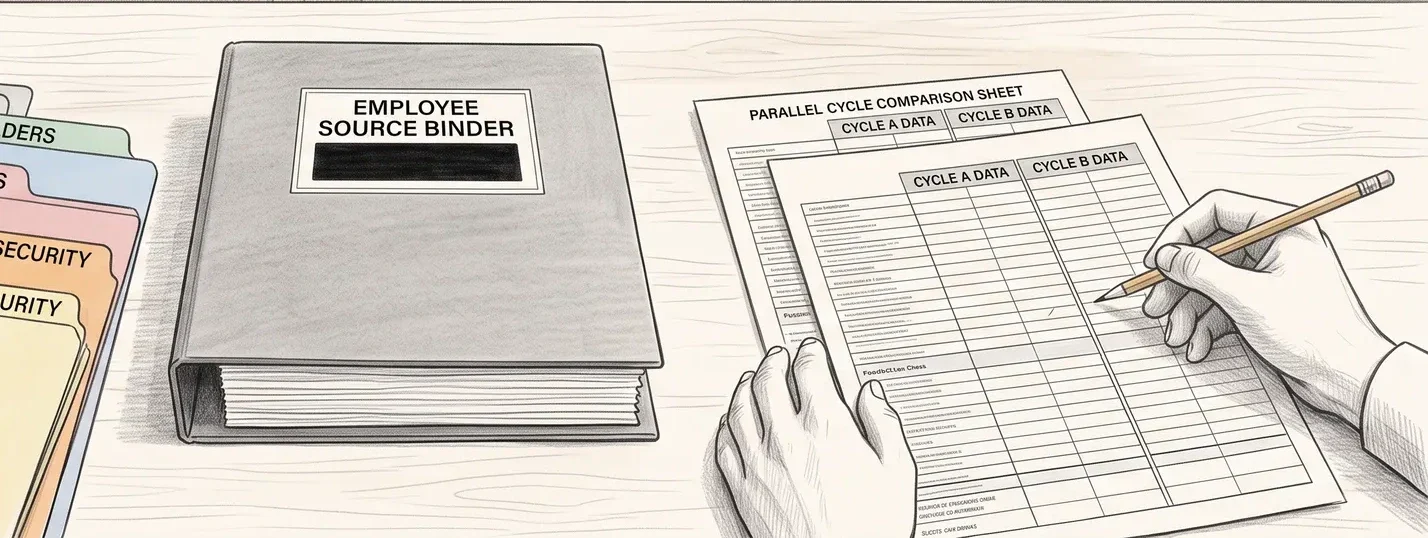
Map each obligation
Name country, format, deadline and accountable owner in one calendar.
Reconcile the source
Keep authoritative employee data and compare payroll with the ledger each cycle.
Test a change
Run a parallel cycle and confirm the local delivery party before cutover.
Qualitative summary of this article's source text, not a measured outcome or performance estimate.
Practical Guidance for Payroll Compliance Review
- Maintain one statutory calendar covering every country, obligation, format and owner. This single artefact prevents more incidents than any system.
- Review employment classification annually, not at hire. Arrangements drift, and the exposure is retrospective and cumulative.
- Put a control on remote-work location changes. Approval should include a check on tax and permanent establishment implications before the move, not after the first pay run.
- Keep one authoritative employee data source. Where HR, payroll and finance each hold a version, reconciliation failures become filing failures.
- Reconcile payroll to the general ledger every cycle. Monthly reconciliation catches errors while they are still correctable; annual reconciliation catches them after they have been filed twelve times.
- Know who actually performs the work in each country. Global providers subcontract; the subcontractor is your compliance exposure and should be named in the contract.
- Document termination calculation rules per country before you need them. These are performed rarely, under pressure, and are a frequent source of disputes.
- Run a parallel cycle before any provider or platform change. Payroll is the last process that should be cut over on faith.
The Regional Dimension
Gulf payroll has a structural feature that changes the risk profile: much of it is directly visible to the state. Wage protection systems in the UAE, Saudi Arabia and several neighbouring markets require salary payments to be routed through approved channels with files submitted to the authorities. This means payroll is not an internal matter that surfaces at year end — late, incomplete or mismatched submissions are visible to the regulator in the same month, and consequences can reach company services such as new visa issuance. The practical effect is that payroll failures in the Gulf escalate to an operational blocker faster than in most jurisdictions. End-of-service gratuity is the second regional specific and the most commonly mishandled. It accrues over an employee's service, varies by length of service and reason for leaving, and differs by jurisdiction and over time as labour law is amended — including the newer savings-scheme alternatives replacing traditional accrual in some settings. Two failures are common: not accruing the liability properly in the accounts, so a wave of departures produces an unexpected charge; and calculating the final settlement using a rule that has since changed. Both are avoidable with a documented calculation basis and a periodic legal review. Social insurance is the third and it is easy to get wrong because it is population-dependent. National employees are enrolled in the relevant national schemes, expatriate employees generally are not, and the distinction interacts with Emiratisation and Saudisation targets, which are measured per entity and carry financial consequences. A group restructuring entities for commercial reasons can change its nationalisation ratio and its contribution obligations without anyone in payroll being consulted. Four further local realities worth building into the process: employment is tied to the sponsoring entity, so intra-group moves are immigration transactions with lead times, not HR record changes; a long chain of external intermediaries — government relations providers, typing centres, insurers, payroll bureaux — handles highly sensitive employee documentation, and that chain is the least documented processing in most regional businesses; weekend days and Ramadan working hours differ across the region, which affects cut-off calendars and overtime calculation; and payslip language and content expectations differ, with Arabic documentation required in several contexts. Regional shared service centres concentrate all of this. A centre in Dubai running payroll for six countries is running six different statutory regimes with one team, and the most common design error is building the process for the largest population and improvising the rest.
The objection worth taking seriously
The honest criticism of consolidation-first advice is that centralising multi-country payroll frequently makes compliance worse before it makes reporting better. Local payroll providers are often small firms with deep knowledge of one jurisdiction, long relationships with the relevant authorities and an instinct for when a rule has changed. Replacing them with a single global contract can substitute a well-branded account management layer for actual local expertise, and the failure is usually invisible until an audit. Several groups that consolidated for reporting benefits discovered they had traded accuracy for a dashboard. There is also a cost argument that cuts against uniformity. Bringing a five-person population onto the group platform, with its integration, testing and local compliance configuration, can cost more than a decade of local provider fees. Uniformity is an architectural preference, not a business case. The balanced position: consolidate the data, not necessarily the execution. A single employee data source, a single statutory calendar, standardised outputs and consolidated reporting deliver most of the management value. Who runs the pay cycle in a given country should be decided on population size, statutory complexity and available expertise — country by country, reviewed periodically, with no requirement that the answer be the same everywhere.
Common Questions
What is the largest compliance exposure in multi-country payroll?
Employment classification, because the liability is retrospective. A person treated as a contractor who is later determined to be an employee generates unpaid contributions, penalties and interest across the whole engagement period, often across several years.
Do remote workers really create tax exposure?
They can. Depending on the individual's role, authority and duration in the country, an employee working from a jurisdiction where the employer has no entity may create a taxable presence or a local employment obligation. It should be a controlled decision with a tax check, not a line manager's approval.
How often should payroll be audited?
Reconcile to the ledger every cycle, review statutory filings quarterly, and run an independent compliance review annually in each material jurisdiction — with the review scope including classification, benefit treatment and termination calculations rather than just whether payments were made.
Where does AI help, and where is it dangerous?
It helps most with the knowledge problem: tracking regulatory changes across jurisdictions, extracting terms from employment contracts to check them against what payroll is actually paying, answering employee queries about entitlements from documented policy, and anomaly detection across cycles — an employee whose net pay jumps, an allowance that appears without a contract change, a gratuity accrual that does not match service length. Those are detection and drafting uses with a human deciding. Where it is dangerous is anywhere the output becomes a filing or a payment without review. A model that confidently produces a statutory calculation from an outdated rule creates an error with legal consequences, and payroll is a domain where the rules change quietly and the penalty for being confidently wrong is paid by employees first.
Payroll Compliance Review — consolidate the data and the calendar; decide execution country by country, because a dashboard is not a substitute for local expertise.