Almost every serious intrusion has the same middle chapter. The attacker gets in through a phished credential or an exposed service, which grants access to very little. Then they find a privileged account — a domain administrator, a service account with excessive rights, a shared root password in a document — and the incident changes character entirely. What was a compromised laptop becomes a compromised enterprise. Privileged access is the multiplier. It is also the control area where the gap between written policy and operational reality is widest, because privilege accumulates through ordinary, well-intentioned decisions: the migration that needed broad rights and was never scoped back, the service account created with administrator permissions because it was quicker, the vendor account left active after the project closed, the shared credential four people know because rotating it would break something nobody has time to identify.
The five places privilege actually hides
Standing administrative rights on daily-use accounts. An administrator who reads email and browses the web from an account with elevated privilege has collapsed the distinction between a user compromise and an infrastructure compromise. This remains the most common and most consequential finding in any assessment. Service accounts nobody owns. Non-human accounts running applications, integrations and scheduled jobs. They typically have static passwords that never change, excessive permissions granted during troubleshooting, and no named owner. In many environments they outnumber human privileged accounts several times over. Shared credentials. The root account, the network device password, the ERP superuser login shared by the finance system team. Shared credentials destroy attribution: after an incident, nobody can say who did what. Third-party and vendor access. Implementation partners, managed service providers and software vendors holding remote administrative access, often permanently, often through tooling the customer does not monitor. Orphaned privilege from role changes. Someone moves from infrastructure to development and keeps both sets of rights. Over years, long-tenured staff accumulate access that no single role would ever justify. The common thread is that none of these are created by negligence. They are created by delivery pressure and then never revisited, because nothing in normal operations forces a review.
What good looks like, in priority order
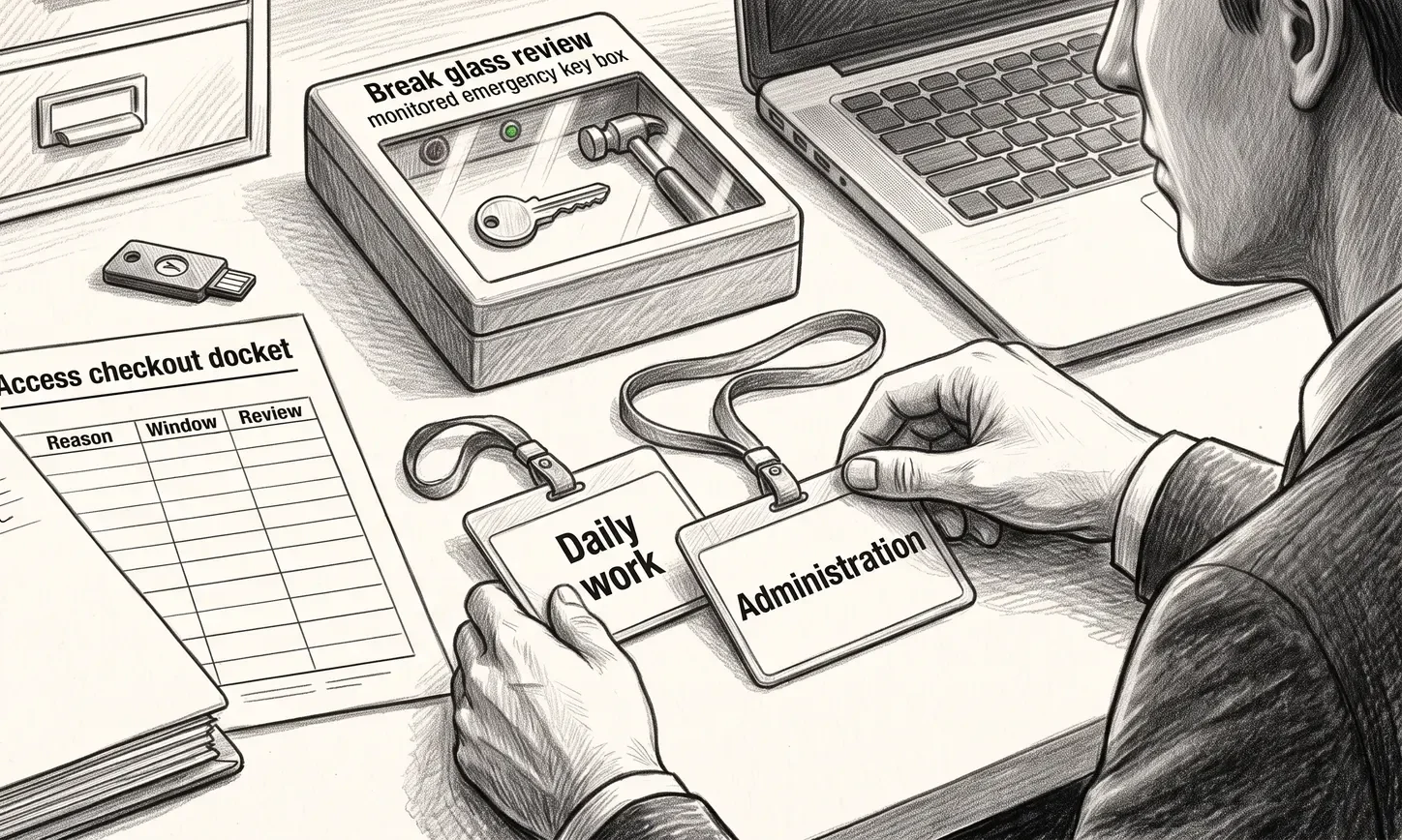
The mature version of this discipline is not a product purchase. It is a sequence, and the order matters more than the tooling. Separate administrative identities from daily-use identities. A distinct account for privileged work, used only from a managed device, never for email or browsing. This one change removes the most direct path from phishing to domain compromise, and it costs nothing but discipline. Eliminate standing privilege in favour of just-in-time elevation. Rights granted for a defined window, with a reason recorded, then automatically removed. The objective is that a stolen credential is usually a credential with no current privilege attached. Vault and rotate shared and service account credentials. Automated rotation, checkout with attribution, and no passwords in scripts, configuration files or documentation. Start by inventorying service accounts — the count alone usually changes the conversation with leadership. Record and monitor privileged sessions. Not for surveillance, but because privileged activity is where the consequential actions happen, and because session recording is the only reliable evidence source after an incident. Govern third-party access as a first-class category. Time-bounded, approved per engagement, through a controlled path, recorded, revoked at project close. Recertify access on a schedule and on role change. Quarterly for the highest tier, and triggered automatically by movers and leavers rather than relying on managers to remember. Protect the identity infrastructure itself. Directory services and identity providers are the highest-value target in any environment; compromise there means every other control is negotiable.
Inventory and separate
Identify owners/dependencies and separate privileged work from daily-use identity.
Control the shared path
Scope and rotate appropriate credentials and time-bound partner access.
Test elevation and recovery
Add elevation where operations tolerate it, with alerts and post-use emergency review.
Qualitative summary of this article's source text, not a measured outcome or performance estimate.
Practical Guidance for Privileged Access Review
- Inventory privileged accounts, including service accounts, before buying anything. Most organisations discover several times the number they expected, and the inventory is the business case.
- Split administrative and daily-use identities immediately. The highest-value change in this category and the cheapest to implement.
- Assign a named owner to every service account. An account with no owner cannot be recertified, rotated or safely disabled, so it persists forever.
- Move to just-in-time elevation for infrastructure and application administration. Standing privilege is the condition attackers depend on.
- Vault shared credentials and remove passwords from scripts and configuration. Credentials in source control and deployment scripts are a routine finding and a routine breach cause.
- Time-bound and record all third-party administrative access. Including your integrator and your software vendor's support team.
- Recertify on role change, not only quarterly. Accumulated privilege from internal moves is invisible to periodic review cycles.
- Test whether disabling an unknown service account breaks anything — in a controlled window. Fear of breakage is why these accounts survive; a scheduled test resolves it.
The Regional Dimension
Privileged access in the Gulf has three characteristics that change the risk profile materially. The first is the integrator model. A large share of regional IT estates — ERP, infrastructure, networks, security tooling — are implemented and operated by external partners, and those partners hold deep administrative access, often persistently, often via their own remote access tooling rather than the customer's. This is a rational response to a thin local talent market, and it means the most privileged users of many regional environments are not employees. Three questions usually go unanswered: which named individuals at the partner hold access, whether their credentials are personal or shared across the partner's team, and what happens to that access when a partner employee resigns. The contractual position is frequently silent on all three, and the customer inherits the partner's staff turnover as an access control problem. The second is workforce mobility. High turnover across the region makes joiner-mover-leaver discipline the single most load-bearing process in identity management, and it is complicated here by the link between employment and residency. A departing employee's system access, their visa cancellation, their final settlement and their handover are handled by different functions on different timelines, and the access revocation is frequently the slowest. Organisations should tie deprovisioning to the HR event that is legally mandatory — the labour and immigration process — rather than to a manager remembering to raise a ticket. The third is operational technology. Energy, utilities, ports, aviation and manufacturing operate control environments with long equipment lifecycles, vendor-supplied maintenance access and engineering workstations that in practice hold standing privilege into systems with physical consequences. OT privileged access is usually governed by a different team, a different vendor relationship and a weaker control set than the IT estate, and the boundary between them is the thing worth testing. Regulatory pressure has helped. National cybersecurity control frameworks in the UAE and Saudi Arabia, central bank requirements for financial institutions, and sector regulators for critical infrastructure all specify privileged access requirements explicitly, which has moved this from a security team aspiration to an audited obligation for regulated entities. The gap now sits in the mid-market, where the same integrator dependency exists with none of the oversight.
The objection worth taking seriously
The honest criticism is that privileged access management has a deserved reputation for being painful to deploy and for pushing engineers toward workarounds. Deployments overrun regularly. Discovery finds thousands of service accounts with unclear dependencies, rotating a credential breaks an integration nobody documented, and just-in-time elevation adds friction at the exact moment an engineer is trying to restore a production service. The predictable human response is a break-glass account that becomes a routine account, an approval process that gets pre-approved, or a personal script holding a static credential — and the control ends up existing in the audit report rather than in the environment. There is also a genuine operational tension. During a major incident, engineers need broad access quickly, and a control designed to prevent an attacker escalating privilege will also slow down the people trying to recover. A poorly designed emergency path is a security hole; the absence of one is an availability risk. Both failure modes are real and the balance is a judgement call, not a best practice. The pragmatic sequence: start with identity separation and service account inventory, which deliver most of the risk reduction and require no product. Add vaulting and rotation for the shared credentials that matter. Introduce just-in-time elevation where the operational pattern tolerates it, and design the break-glass path deliberately, with alerting on use and a mandatory post-use review. Attempting full coverage in one programme is how these projects acquire their reputation.
Common Questions
Where should a privileged access programme start?
With an inventory, then with separating administrative identities from daily-use ones. The inventory almost always reveals a service account population large enough to reframe the problem, and identity separation removes the most common escalation path at near-zero cost.
How should service accounts be handled?
Named owner, documented purpose, scoped permissions, vaulted credential with automated rotation, and no interactive login. The hard part is the dependency mapping, which is why disabling candidates in a controlled window is more effective than trying to document everything first.
How do we control our implementation partner's access?
Named individual accounts rather than a shared partner credential, access granted per engagement with an end date, routed through your access path rather than their remote tooling, recorded, and contractually required to be revoked when their staff leave. Put it in the contract, because retrofitting it is much harder.
Does AI create new privileged access problems?
It creates a new category of privileged identity that most access reviews do not cover. Agents, copilots and automation connected to business systems hold credentials and act on behalf of users, often with broader permissions than any individual needs because the integration was scoped for convenience. The governance questions are the same ones asked of service accounts — who owns it, what can it reach, is the credential rotated, is the activity recorded — but the behaviour is less predictable, because the action taken depends on an instruction that may itself have been injected through content the system read. Treat every AI integration as a privileged service account with an unusually large blast radius, inventory them alongside the rest, and log what they actually did rather than what they were configured to do.
Privileged Access Review — start with the inventory and identity separation; most breaches escalate through privilege that accumulated for perfectly reasonable operational reasons.