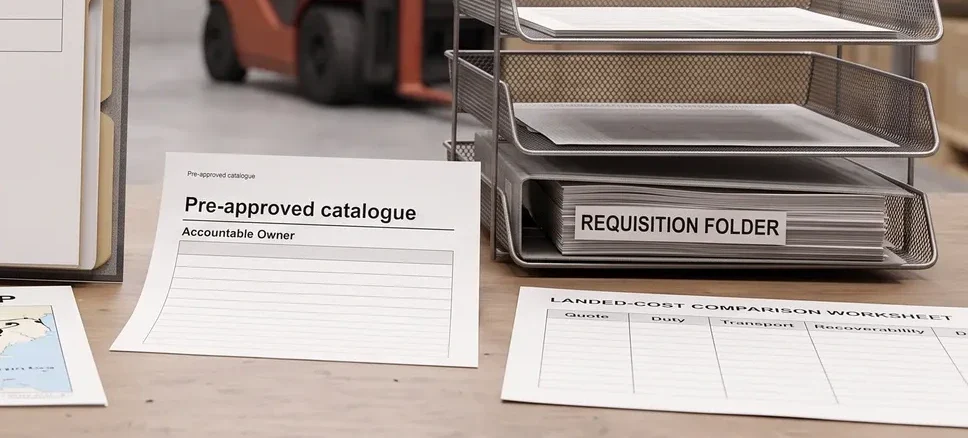
American consumer prices rose 8.3 per cent in the year to April, according to figures published yesterday, and the supplier increase letters arriving in procurement inboxes every week say much the same thing in less polite language. Steel, resin, freight, packaging, energy, labour — the notices differ only in the percentage. This breaks the traditional procurement playbook. For twenty years the savings conversation meant negotiating the unit price down. In 2022 the negotiation is about the size of an increase, and a buyer who holds a supplier to five per cent instead of nine has done well while the budget still goes up. Meanwhile the money that is genuinely recoverable sits somewhere else entirely: in cycle time, specification, demand, and the quiet premium paid every time somebody buys outside the process because the process was too slow.
Five places the money actually is
Demand. Do we need it, how much, how often, and who decided? The largest savings in most organisations come from buying less, not buying cheaper, and nobody owns the question. Specification. Over-specification is the most expensive habit in procurement and the hardest to challenge, because the person who wrote the specification is usually senior to the person questioning it. Industrial-grade where commercial-grade would serve, three-year warranties on items replaced annually, branded consumables in machines that accept generics. Process cost. The requisition-to-order cycle, the approval hops, the rework caused by incomplete requests, the chasing. Off-contract buying. Spend that bypasses negotiated agreements and pays list price, usually because the sanctioned route was slower than the need. Payment terms. Now a live commercial variable rather than an afterthought, in both directions. Unit price is the sixth item. It gets ninety per cent of the attention and, this year, delivers the least.
Slow procurement is a price increase you pay to yourself
The cycle time from requisition to purchase order looks like an administrative metric. It is a price. When the cycle runs at five days and the operational need arrives in two, the organisation adapts: the site buys locally at retail, someone pays expedited freight, a call goes to the supplier who can deliver tomorrow at a premium, or production stops. Every one of those adaptations costs real money, and none of it appears in a savings report because it is recorded as an ordinary purchase. Measure it directly. Pull a quarter of purchase orders, identify every expedited shipment, every off-catalogue buy of a catalogue item, and every order raised after the invoice arrived. Price the difference against the contracted equivalent. In most mid-sized organisations that number is larger than the entire annual savings target, and it is caused by internal latency rather than by supplier behaviour.
Off-contract buying is a measurement problem, not a morality problem
The standard response to maverick spend is a memo. It never works, because people are not buying off-contract out of indiscipline. They are doing it because the sanctioned path takes longer than the work allows. Start by measuring: what proportion of spend has no purchase order before the invoice, broken down by category and by site? The pattern will be specific. It is rarely spread evenly — it is two categories, three sites and one manager with an urgent operational problem. Then fix the path for those cases: catalogues with pre-agreed prices, a low-value fast lane with a single approver, purchasing cards with category restrictions for genuinely small items. Police only after the sanctioned route is faster than the workaround.
The approval chain nobody has audited
Most approval matrices were designed to prevent fraud and deliver neither speed nor control. Five sequential approvers mean five chances to sit in a queue, and diffuse accountability so completely that none of the five reads anything. Three changes usually fix it. Approve by value band with one named approver per band rather than a chain. Run any genuinely required second approval in parallel rather than in series. And remove approval entirely for pre-approved catalogue items within budget, on the grounds that the decision was already made when the catalogue was agreed. The control that matters is not the count of approvers; it is whether spend is visible against budget before it is committed.
Three-quote theatre
The requirement to obtain three quotes for every purchase above a low threshold produces more fiction than competition. Everybody in procurement knows what actually happens: the preferred supplier is asked to help, and two comparison quotes appear. The rule adds days, generates paperwork and creates the appearance of diligence with none of its substance. The replacement is unglamorous. Run real competitive events annually for the categories that account for most of the spend. Use catalogues and framework agreements for routine items. For everything else, allow single-source purchasing with a written justification and a named approver who owns the decision. Concentrating genuine competition where it matters delivers more than distributing fake competition everywhere.
| Cost driver | Evidence to review |
|---|---|
| Demand and specification | Required quantities and justified technical requirements. |
| Internal delay | Expedited shipments and the contracted alternative. |
| Off-contract buying | Category/site and timing of purchase order versus invoice. |
| Payment and landed cost | Cash/credit terms and comparable recoverable landed cost. |
Qualitative summary of this article's source text, not a measured outcome or performance estimate.
Practical Guidance for Procurement Process Review
- Measure requisition-to-order cycle time by category and treat it as a cost metric, not an administrative one.
- Price your emergency premium — expedites, off-catalogue buys and retroactive orders — for one full quarter.
- Report off-contract spend by category and site, then fix the fastest workaround before writing a policy.
- Replace approval chains with value bands and a single named approver at each band.
- Challenge specifications annually with the requesting function in the room and the incumbent supplier absent.
- Retire the universal three-quote rule in favour of real competition on the top categories.
- Separate cash savings from cost avoidance in every report, and only count the former where a budget line falls.
- Track supplier count per category; fragmentation is usually a symptom of a slow process rather than a sourcing strategy.
The Regional Angle
Three features of regional buying change where the savings sit, and the first is almost never in the system. Suppliers here quote two prices: a cash price and a credit price. The difference for thirty, sixty or ninety days is frequently large enough that, annualised, it represents a financing rate well above anything your bank charges — and with the cost of money rising this year, that embedded rate has become a live treasury question rather than a piece of trading folklore. Almost no purchasing system records both numbers. The order is raised at the credit price, the discount forgone is invisible, and nobody in finance can see that the business is borrowing expensively from its suppliers one purchase order at a time. Capture both prices as fields, report the total discount forgone each month, and put that number in front of treasury. In several organisations it is the largest single recoverable amount in the entire procurement portfolio. The second is landed-cost comparability. A quote from a mainland supplier, a quote from a designated-zone supplier and a quote from an overseas manufacturer are not comparable numbers, and buyers routinely compare them anyway. Customs duty, clearance and handling, the value added tax treatment and whether it is recoverable by the importing entity, inland transport, and the working capital tied up in transit all differ. The discipline is dull and it pays: build one landed-cost template, require every quote above a threshold to be converted into it before comparison, and store the converted figure rather than the quoted one. Groups that do this discover that the cheapest quote lost about a third of the time. The third is who is doing the buying. The regional purchasing role evolved as an expediting role — chasing deliveries, coordinating clearance, managing drivers, solving today's shortage — and that work is genuinely valuable and genuinely full-time. But it is not category management, and the savings described above require somebody to own a category across a year rather than an order across a week. The market for experienced category managers here is thin and expensive, and the supplier market in many categories offers three credible bidders rather than eight. Both facts point the same way: the achievable savings are concentrated in demand and specification, which you control, rather than in competitive tension, which you mostly do not. Staffing accordingly — one category owner working through the top five categories — beats hiring two more expediters.
The objection worth taking seriously
The strongest objection is bluntly commercial. The finance director asked for savings, and cycle time is not savings. Process metrics do not reduce spend, cannot be banked, and tend to appear in procurement reports precisely when real price reductions are unavailable. Worse, in a year of scarcity the binding constraint is not price but availability: when a supplier offers an allocation with four hours to confirm, process discipline is what makes you lose it. Rigid procedure in a shortage is a way of paying more later. That is right about the current market, and any framework that ignores availability deserves to be ignored. But the emergency premium is cash, it is measurable, and it is traceable to specific orders — so it belongs in the savings column rather than the process column. Demand and specification are the only two levers that still work when prices rise for everyone, because they change what you buy rather than what you pay. And the scarcity argument actually supports the case rather than undermining it: a four-hour decision window is exactly why an organisation needs a pre-authorised fast path with a single accountable approver, instead of a five-step chain that assumes time exists. Design for speed with controls attached, rather than controls that assume slowness is free.
Common Questions
What is the first thing to measure?
The proportion of spend without a purchase order raised before the invoice, split by category and site. It takes a day to produce and tells you where the process is failing people.
Do purchasing cards help?
For genuinely low-value, high-frequency items, yes — with category restrictions and monthly reconciliation. They are a bad answer for anything that should sit under a contract.
How do we handle constant price increase letters?
Require the increase to be evidenced against a published index or input cost, apply it from a stated effective date rather than retroactively, and use the conversation to trade term length or volume commitment for a smaller rise.
What should we expect over the next twelve months?
Expect increase letters to keep arriving while energy and freight remain elevated, and expect quote validity to shorten from weeks to days. Expect suppliers to push for shorter payment terms at the same time as your own treasury wants longer ones, making terms a negotiated item in every contract. Expect index-linked pricing and surcharge clauses to become normal in supply agreements rather than exceptional. Expect the Shanghai backlog to clear unevenly, which means lead-time volatility rather than a clean recovery. And expect requests for more procurement headcount to be declined, which leaves process as the only lever anyone will fund.
Procurement Process Review — we price your emergency premium, measure the cycle time that creates it, and rebuild approvals so the sanctioned route is faster than the workaround.